Table of Contents
ToggleLeague of Legends coaching has become a mainstream way for players to break through skill plateaus and climb the ranked ladder faster. Whether you’re stuck in Gold and can’t figure out why, or you’re a Diamond player aiming for Masters, the right coach can accelerate your improvement by months. The meta shifts constantly, patch changes ripple through the game every two weeks, and understanding how to leverage your champion pool in the current environment isn’t something most players figure out alone. Coaching cuts through the noise, it gives you personalized feedback, targets your specific weaknesses, and teaches you to think like a high-elo player. This guide covers everything you need to know about League of Legends coaching: what it is, how to find a quality coach, what to expect, and whether it’s actually worth your time and money.
Key Takeaways
- League of Legends coaching accelerates rank progression by identifying recurring mistakes and providing personalized feedback that players typically miss during solo queue grinding.
- Quality coaches should be Grandmaster rank or former pro players with documented teaching experience and student testimonials, not just mechanical skill.
- Effective League of Legends coaching focuses on macro play, champion mechanics, decision-making, and mental resilience—teaching players how to think like high-elo competitors rather than just copying strategies.
- Players who invest in coaching typically rank up 1-2 divisions within 2 months, compared to months of slower progression without professional guidance.
- Self-coaching through replay reviews and community feedback groups offers a free alternative, but external coaching eliminates personal blind spots and provides expertise that most players cannot achieve alone.
What Is League of Legends Coaching?
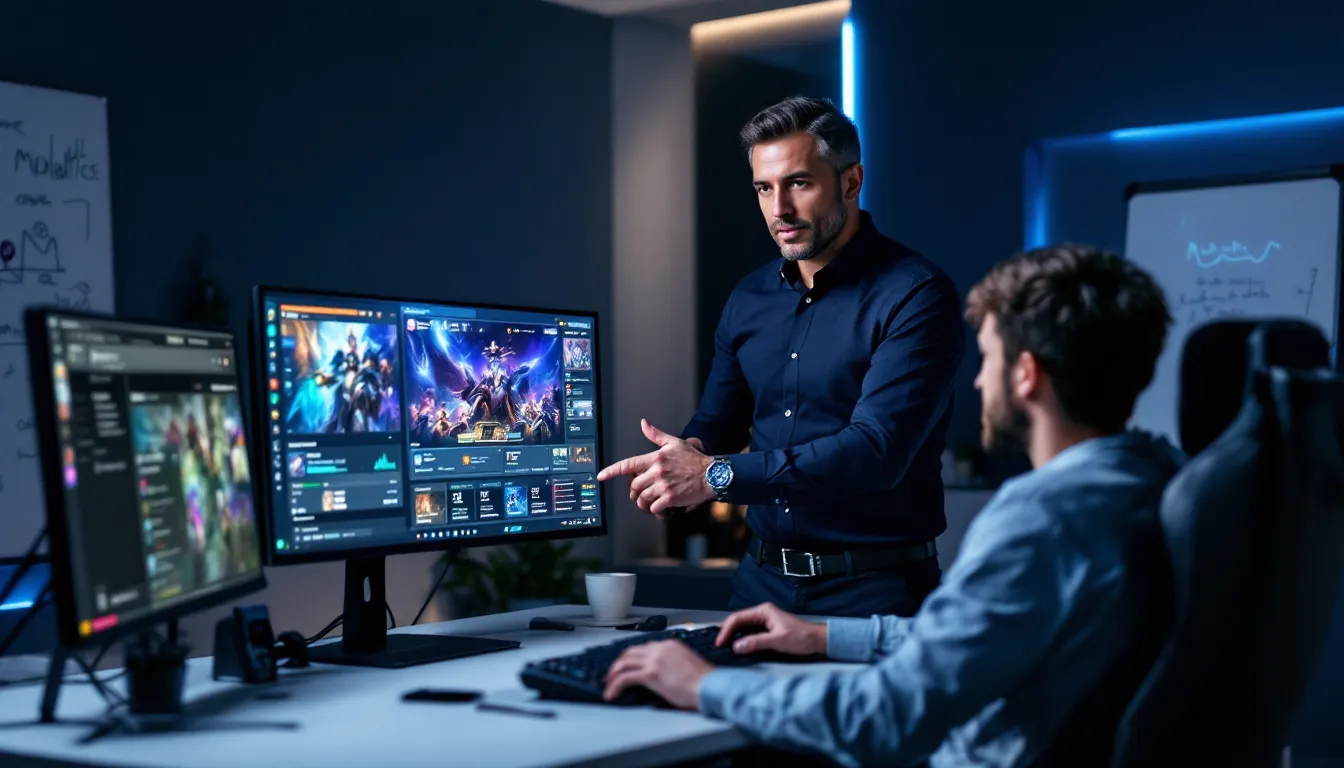
League of Legends coaching is personalized training from an experienced player, usually Diamond rank or higher, often Challenger, who analyzes your gameplay, identifies mistakes, and teaches you how to improve. A coach watches your replays, plays alongside you in real matches, or reviews VODs (video-on-demand recordings) of your games to spot recurring errors you might not catch yourself.
Unlike watching a YouTube guide or reading a matchup spreadsheet, coaching is interactive and tailored to your champion pool, your playstyle, and your rank. A coach might tell you that your wave management in the first 10 minutes is costing you kills, or that you’re overextending on the map without vision control. They teach you the why behind decisions, not just the what.
Coaching ranges from casual “let me review your game real quick” advice from a friend to structured, multi-week programs with specific goals, assignments assignments, and progress tracking. Some coaches focus purely on mechanical improvement: others emphasize macro play, decision-making, or psychological resilience under pressure. The format varies too, some are session-based, others are ongoing partnerships.
Why Coaching Matters for Competitive Improvement
Most players improve slowly on their own. You play games, you win some and lose others, and over months you might climb a division or two. But the learning curve flattens hard once you hit your current skill ceiling. You keep making the same mistakes because you can’t see them. Your mental game deteriorates after a loss streak. You don’t understand why a pro player builds an item differently than you do.
Coaching accelerates growth because it adds external perspective. A coach catches patterns you’d miss in 100 hours of solo queue. They explain when and why a decision matters, not just that it’s “wrong.” This is the difference between grinding and learning.
For competitive players, coaching also shortens the time between identifying a weakness and fixing it. Without coaching, you might spend weeks grinding a matchup without understanding the root issue. With a coach, one or two sessions can clarify exactly what’s holding you back. Players who invest in coaching often report ranking up 1-2 divisions faster than their pre-coaching trajectory. That’s not magic: it’s focused, efficient practice.
Beyond mechanics, coaching helps with mental game. League is a 40-minute commitment where a single bad teamfight can cost the game. Learning tilt management, decision-making under pressure, and how to reset after a loss is harder to teach yourself. A coach can normalize these challenges and give you concrete strategies to handle them.
Types of League of Legends Coaches and Coaching Services
Not all coaching is the same. Understanding the different types helps you pick what fits your needs and budget.
Professional Coaches vs. Content Creator Coaches
Professional coaches are often ex-pro players or high-elo specialists with years of tournament experience or ranked grind. They typically coach full-time, have structured programs, and work with multiple students. Examples include coaches affiliated with esports organizations or established coaching platforms. They tend to be more expensive (often $50-150 per hour) but offer deeper expertise, especially in high-level macro play and psychological coaching.
Content creator coaches are streamers, YouTubers, or community figures who offer coaching alongside their content creation. They’re often more accessible and personable, with pricing ranging $20-60 per hour. The trade-off: they may have less structured programs and less availability, since coaching is secondary to streaming. That said, many content creators are excellent coaches, they’ve built their reputation on teaching, and they understand how to break down concepts for viewers.
One-on-One Sessions vs. Group Coaching Programs
One-on-one sessions are traditional, focused, and intense. You pay for a coach’s full attention for 60-90 minutes. They review replays, answer your specific questions, and design assignments tailored to your weaknesses. This is ideal if you have targeted problems, like struggling in matchups or not understanding roam windows. One-on-one costs more per hour but is the most efficient format for rapid improvement.
Group programs are structured courses, often with modules, assignments, and community access. Think “League 101: Macro Fundamentals” where 20 players watch lectures, complete challenges, and discuss in a Discord. Group programs are cheaper per person ($200-500 for a full course) and work well if you’re a self-motivated learner who wants foundational education rather than personalized debugging. Some programs also include one-on-one time within the larger course.
Hybrid models combine both, a group curriculum with optional one-on-one sessions. These often offer the best value if you can commit to both the group modules and occasional 1v1 refinement.
How to Find and Choose the Right League of Legends Coach
Finding a coach is straightforward: finding the right coach takes more care. A bad coach wastes your money and time. A great coach accelerates you months ahead.
Evaluating Coach Credentials and Experience
Start by checking rank and champion pool. If a coach claims to teach top lane but is only Diamond 3, that’s a red flag for top lane specifically, top is one of the most rank-dependent roles because wave management and roaming timing vary wildly by elo. Ideally, your coach is at least Grandmaster (top 0.1%) or was a pro player. That said, a solid Diamond coach in mid lane can absolutely help a Platinum mid laner improve. Consider the context.
Look for coaches with documented teaching experience. If they’ve been streaming coaching sessions, have student testimonials, or run a community, that’s proof they can explain concepts clearly. A talented player isn’t always a good teacher. Ask yourself: Can this person articulate why something works, or do they just “feel” their way through the game?
Verify their track record with students. Have past clients ranked up? Do they leave positive reviews? Discord communities, Reddit threads, and coaching platforms like Mobalytics often have verified coach reviews and student feedback. Spend 15 minutes reading reviews before committing.
Consider specialization. Some coaches focus on specific roles, champions, or elo brackets (Silver-Gold vs. Masters+). A coach who specializes in climbing out of hardstuck Gold with jungle main advice is different from a coach teaching high-elo team coordination. Match the coach’s expertise to your needs.
Budget Considerations and Pricing Models
Coaching pricing varies widely. Expect $20-30/hour for newer coaches, $40-80/hour for established mid-tier coaches, and $100-300+/hour for ex-pros or Challenger specialists. Group programs are typically $150-800 for 4-12 weeks of content.
Don’t assume expensive equals better. A $50/hour coach with great student reviews might be better than a $150/hour coach with minimal track record. That said, extremely cheap coaching ($10/hour) is often low-effort feedback. You get what you pay for.
Consider your budget realistically. If you can afford one session, get a “vibe check” session first, 30-60 minutes to see if the coach’s teaching style clicks with you. Some coaches offer money-back guarantees or trial sessions. If you’re serious about ranking up, budgeting $200-400 for 4-6 sessions over 2-3 months is a reasonable starting point.
When comparing prices, look at what’s included. Some coaches provide assignments, VOD reviews between sessions, or Discord community access. Others charge per minute. Calculate the effective cost and value per session, not just the hourly rate.
What to Expect in Your First Coaching Session
Your first session typically runs 60-90 minutes and is diagnostic. The coach will gather information about you and identify priority areas.
Expect questions: What’s your current rank? How long have you been playing? What role/champion pool? What’s your goal (hit Gold, improve macro, climb to Challenger)? What aspect of the game frustrates you most? A good coach listens more than talks in the first session.
Most coaches will ask to review one or two of your recent replays or watch you play live. They’re looking for patterns, not just one bad play, but recurring mistakes. Maybe you lose every teamfight because you’re positioning too far forward. Maybe your CS drops off after 15 minutes. Maybe you never track the enemy jungler. These patterns reveal what to focus on.
The coach will then explain what they saw, prioritize 2-3 main points to work on, and outline a plan. Don’t expect a full coaching curriculum in session one. A realistic first session ends with clarity on your weakness and a assignments assignment, “play 5 games focusing on CS management” or “watch this VOD of a pro player in your matchup and note how they kite.”
By the end, you should feel understood, not overwhelmed. A good coach makes you believe your improvement is possible and explains why they’re focusing on what they’re focusing on. If you leave confused or feeling like the coach didn’t listen, consider a different coach.
Come prepared with replays and an open mind. Mute your ego, the feedback might sting, but that’s the point. The best coaches will be direct about your mistakes and optimistic about your potential.
Key Skills and Topics League of Legends Coaches Focus On
Effective coaches don’t just say “play better.” They break improvement into concrete, teachable skills. Here’s what quality coaching typically covers.
Macro Play and Map Control
Macro, the big-picture strategy of grouping, objective control, wave management, and rotations, is often the biggest differentiator between elo brackets. A Gold player knows how to CS and fight 1v1. They lose games because they’re in the wrong place at the wrong time, or they take a fight when Baron is up on the other side of the map.
Coaches teach wave management: when to push, when to reset, how to set up roam opportunities. They teach objective prioritization: why take this jungle camp now instead of that one? They teach macro timing: when the enemy ADC is no longer a threat because they’re trapped under tower, your team should push for towers or drake.
This often involves watching VODs of professional players and comparing your decision-making to theirs. A coach might pause a replay and ask, “What should you do here?” Then show what the pro player did and why. Over time, you internalize better decisions.
Champion Mechanics and Laning Phase
Mechanics, your ability to execute a champion’s kit efficiently, matter hugely in lane. Can you kite as an ADC? Do you know your champion’s damage rotation? Can you animation-cancel auto-attacks? Are you using your Q correctly?
Coaches identify mechanical gaps and assign practice drills. They might say “spend 10 minutes in practice tool comboing your full rotation 50 times” or “play 3 games focusing only on landing your key spell, ignore CS for now.” Mechanical improvement is unglamorous but essential, especially in lower elos where sloppy play costs teamfights.
Laning phase coaching is specialized because laning dictates the entire game. A coach might teach you how to track the enemy jungler during lane, when to push for lane priority, or how to secure a kill on an opponent without dying. These micro-skills compound into a massive advantage by 15 minutes.
Decision-Making and Game Sense
Game sense is the ability to “feel” the right play even without perfect information. It’s why pros never seem to be in the wrong place. How do they know to group mid instead of farm bot? How do they sense a jungler gank coming?
Game sense is built through experience but accelerated through coaching. A coach teaches you to ask better questions: “Where are all 5 enemies?” “What’s the win condition for a teamfight?” “Does my team have the DPS to burst their carry?” They teach you to read the map constantly and assign probabilities to enemy positions.
This is where replays are gold. A coach pauses your game and asks, “Why did you face-check that bush?” You answer. They explain the right thinking: “No vision, no reason to go there, no ally nearby.” Repeated exposure to this analysis retrains your instincts.
Mental Game and Tilt Management
You can be mechanically perfect and still lose games because you tilt. You die once, then play scared. You lose a teamfight, then make awful decisions the next one. You’re up 3 kills and throw the game because you’re arrogant.
Good coaches address this directly. They might teach you to take breaks after two consecutive losses. They might explain that a death isn’t a personal failure, it’s data. They normalize setbacks and teach emotional regulation. Some coaches use sports psychology techniques like pre-game visualization or post-loss reviews that focus on learning, not blame.
This is surprisingly powerful. Players often find that their mechanical skill hasn’t changed, but their consistency and win rate improve just from mental game coaching.
How Coaching Accelerates Your Rank Progression
Without coaching, climbing is slow. You play hundreds of games, gradually improve, and over a season climb 1-2 divisions. With coaching, you can often climb that much in 1-2 months.
Here’s why: Uncoached players grind inefficiently. They repeat the same mistakes. A player might play 100 games of top lane without realizing they’re never tracking the enemy jungler, costing them kills and deaths every other game. A coach identifies this in 30 minutes. They assign a simple habit: “Look at minimap every 5 seconds.” Suddenly, the same player’s win rate goes up because they’re dying less.
Coaching also eliminates the “skill ceiling illusion.” Players often think they’re at their natural limit. A coach shows them that limit doesn’t exist, their mistakes are learnable, fixable gaps. This psychological shift combined with targeted practice usually yields results in 2-4 weeks.
The most common outcome: players rank up 1-2 divisions within 2 months of starting coaching, assuming they’re coachable (meaning they apply feedback, play consistently, and don’t make excuses). Some climb faster: some slower depending on starting rank and practice volume. Coaching doesn’t guarantee climbing, you still have to execute, but it dramatically shortens the timeline.
Rank progression also gets easier as coaches help you identify your peak performance. You stop grinding when tilted. You focus on best-of-five decision-making instead of grinding 200 solo queue games. Efficiency matters more than volume.
Common Mistakes Coaches Help You Avoid
Coaches aren’t just teachers: they’re mistake detectors. Here are the most common errors they catch and correct.
Poor champion pool focus. Many players play 8-10 champions, thinking versatility is strength. Coaches teach the opposite: playing 2-3 champions deeply gets you to higher elo faster. You learn matchups, optimize builds, and focus mental energy on macro instead of mechanics. A good coach helps you identify which champions fit your playstyle and win rate, then encourages you to one-trick or two-trick.
Chasing kills instead of playing for win conditions. Players see a low-health enemy and tunnel vision. A coach teaches you to ask: “Does chasing this kill help us close the game?” Sometimes it does. Often, it doesn’t. Learning to resist the dopamine hit of kills in favor of winning is huge.
Not recording or watching replays. You can’t improve if you don’t know what you did wrong. Coaches force this habit. They might assign “watch your last 3 losses and write down 3 mistakes per game.” This sounds tedious, but it’s transformative. You become your own coach over time.
Taking the wrong trades in lane. Newer players trade HP when the trade is unfavorable. You take 40 damage to deal 20 damage. Repeated, you run out of HP first and die. Coaches teach you to evaluate trades: Does this setup a kill for me? Does this improve my mana efficiency? Is this worth the HP I’m spending? This compound knowledge turns laning around.
Overestimating vision control. A player thinks they’re safe because their ward is up. A coach teaches them that one ward is not enough information. Your team needs multiple wards, constant map awareness, and defensive positioning until you know where enemies are. This prevents unnecessary deaths.
Not muting all-chat or pings. Toxicity is a real distraction. A coach might tell you to disable all-chat and mute non-support pings. It sounds silly, but removing flame and blame, whether from others or self-directed, improves focus and decision-making. The toxic atmosphere of League is real: coaches help you isolate from it.
Alternatives to Traditional Coaching
Coaching is effective but isn’t the only path. Alternatives exist and can work depending on your learning style, budget, and consistency.
Self-Coaching Strategies and Free Resources
You can coach yourself. It’s slower than hiring a coach, but free. Start by recording and watching your replays. Use the replay system to review your last 5 games weekly. Ask: “What went wrong?” “Did I make the same mistake?” “What would a pro player do here?” Over months, this builds self-awareness and game sense.
Free resources abound. Platforms like Mobalytics offer champion matchup data, build recommendations, and tier lists broken down by elo. Community guides on Reddit or community sites explain macro concepts. YouTube channels from pro players break down decision-making. Dot Esports covers competitive meta shifts and professional strategy.
The limitation of self-coaching: you’re blind to your own biases. You think you’re playing well and don’t see the mistakes. A coach sees them immediately. Self-coaching works best if you’re already a strong analytical player and high-discipline learner. Most players benefit from at least a few external perspectives.
Community Learning and Peer Feedback
Playgroups, Discord communities, and coaching circles, groups of players who watch each other’s replays and give feedback, can provide low-cost improvement. You might find a group focused on your role or elo bracket where members critique each other’s games once weekly. The feedback isn’t as refined as a pro coach’s, but it’s honest, actionable, and builds community.
Finding these: Search Reddit (r/leagueoflegends, role-specific subs), join Discord servers focused on your role, or ask in your friend group if anyone wants to start a replay review circle. The best groups have 4-8 people, high engagement, and a commitment to honest feedback.
The advantage: low cost, peer learning (sometimes a friend’s perspective clicks differently than a pro coach’s), and camaraderie. The disadvantage: inconsistency and less expertise than paid coaching. That said, for players unwilling or unable to pay for coaching, community learning is the next best thing. Consistency beats intensity: playing with a group even monthly is better than sporadic solo grinding.
Conclusion
League of Legends coaching has evolved from a niche luxury to an accessible investment for serious players. Whether you’re trying to hit Platinum, break out of elo hell, or optimize your path to Masters, the right coach can compress your timeline and prevent years of spinning your wheels.
The key is matching your coach to your goals and learning style. A pro player’s teaching approach might not suit you: a mid-tier content creator might be perfect. Budget matters, but cheap isn’t always worse. Results matter most: coaches whose students consistently rank up are worth paying for.
If you’re not ready for coaching, self-coaching through replays and community feedback still works, it just takes longer. But if you can afford $200-400 for 4-6 sessions, the ROI in rank progression and confidence is usually worth it.
The meta continues to shift with patches, but the fundamentals, macro play, champion mechanics, decision-making, and mental resilience, remain constant. A good coach teaches you how to learn, not just what to learn. That skill carries forward as the game evolves. Pick a coach, commit to the work, and watch your rank climb.